
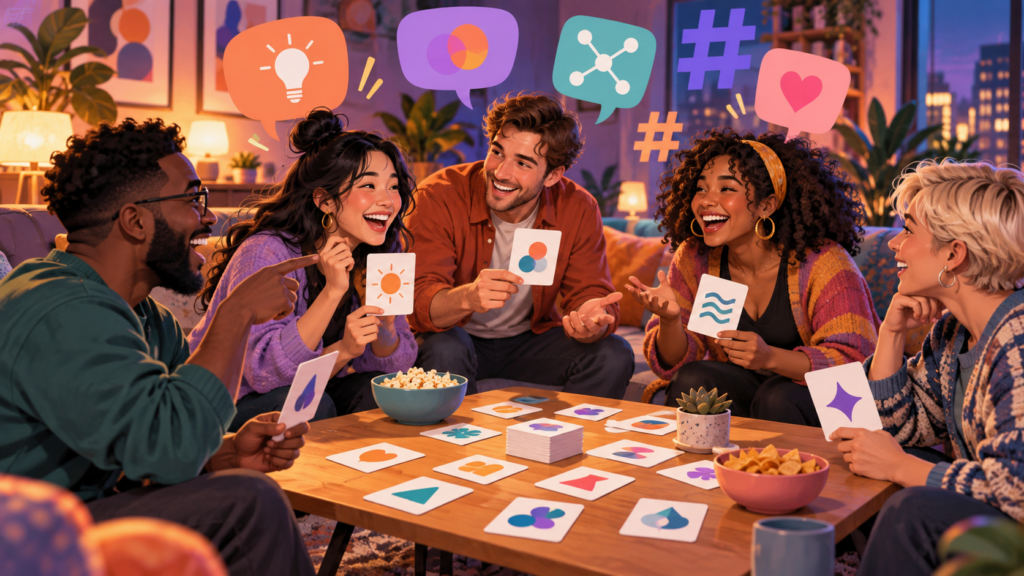
A hashtag is a tiny piece of language with an unusual ability: it can compress a story, opinion, joke, or shared experience into a few memorable words. That makes hashtag-inspired prompts ideal for social party games. They are familiar enough to understand quickly, flexible enough to reward creativity, and short enough to keep a room moving. Players do not need deep trivia knowledge or complicated equipment. They need only a prompt, a playful point of view, and a group willing to build on one another’s ideas.
The best hashtag games are not simply social-media simulations. Around a real table, the format becomes a tool for conversation. It encourages people to notice how differently their friends interpret the same theme. A prompt about a disastrous vacation might produce a literal travel complaint, an absurd movie title, a personal memory, or a perfectly timed pun. The surprise comes from comparing those approaches.
Why the format is easy to learn
Many party games lose energy during a long rules explanation. Hashtag challenges avoid that problem because most players already understand the basic grammar: combine words into a compact label that captures an idea. A host can demonstrate one sample round in less than a minute, then let the group learn by playing.
This low entry barrier is useful for mixed groups. A gathering may include close friends, coworkers, relatives, and people meeting for the first time. Complex strategy can favor experienced players, while narrow trivia can exclude anyone unfamiliar with the topic. A broad creative prompt gives everyone a reasonable starting point. The goal is not to know the official answer; it is to create an answer the group recognizes and enjoys.
The psychology of creative constraints
Creativity often improves when the boundaries are clear. “Say something funny” is intimidating because the possibilities are unlimited. “Create a hashtag for a superhero’s worst day at work” immediately provides a character, situation, and tone. The restriction reduces blank-page anxiety and gives the mind useful material to combine.
Short response formats add another productive limit. Players must choose the strongest image or twist instead of explaining an entire story. That pressure favors concise associations, wordplay, contrast, and exaggeration. It also keeps rounds fast. A response that takes twenty seconds to read can be clever, but it changes the rhythm from spontaneous party play to prepared performance.
Design prompts that invite many answers
A strong prompt has enough detail to spark a scene but enough space to support different voices. Themes such as awkward jobs, imaginary products, strange holidays, minor superpowers, pets with opinions, or historical figures using modern technology tend to work well. They connect familiar situations with an unexpected angle.
Avoid prompts that depend on one celebrity, one region, or a very recent meme unless everyone in the group shares that knowledge. References can be fun, but too many make the game feel like a test. It is also wise to mark mature topics in advance and let the group choose the tone. Consent matters in humor. Players should be able to skip a prompt without having to defend the decision.
Online entertainment has similarly varied audiences and boundaries. If adults choose to explore a third-party gaming destination such as Betonklik Login, they should first confirm that access is permitted where they live, review the platform’s terms, and keep personal limits in place.
Choose a scoring system that matches the room
Scoring changes behavior. If one judge selects a favorite response, players may try to match that person’s taste. If everyone votes, broadly accessible jokes gain an advantage. If the goal is simply to share responses without points, quieter or more experimental players may feel safer taking risks.
None of these systems is automatically best. Competitive groups often enjoy rotating judges and keeping a visible score. Family gatherings may prefer team play, where an adult and younger player collaborate. Coworker groups might use anonymous submissions to reduce self-consciousness. A host can even change systems between rounds: start without points, add voting once people are comfortable, and finish with a collaborative challenge.
Make digital tools serve the conversation
Phones can collect anonymous answers, randomize prompts, or display a countdown, but they should not become the center of attention. The memorable part is usually the reveal: hearing each answer, guessing who wrote it, and watching the group respond. If everyone remains focused on a private screen, the social benefit disappears.
A simple hybrid setup works well. The host displays the prompt on one shared screen. Players submit answers on small cards or through a lightweight form. One person reads the responses aloud. The group then votes with tokens or raised hands. This approach uses technology for speed while preserving eye contact and live reaction.
Support different kinds of humor
Fast extroverts are not the only creative players. Some people excel at deadpan answers, subtle references, visual combinations, or callbacks to earlier rounds. A fair game allows a little writing time and does not reward whoever shouts first. Teams can also balance confidence levels and give players a chance to discuss ideas before submitting.
The host sets the emotional standard. Laugh with people, not at them. Discourage responses that target a player’s identity, appearance, private experience, or vulnerability. A clever party game should leave the group feeling more connected. The easiest rule is that playful embarrassment may be fictional or self-directed, while personal boundaries remain real.
Create a satisfying session arc
A good session builds gradually. Begin with universal topics such as food, weather, school, or household objects. Move toward imaginative scenarios after the group understands the rhythm. Save callbacks and multi-part challenges for later, when shared jokes have formed. Ten to fifteen rounds are often enough; stopping while energy is high is better than stretching until every answer feels forced.
Hosts can prepare optional variations. In a “remix” round, players combine two earlier answers. In a “headline” round, each hashtag must imply a complete news story. In a cooperative finale, the group creates a chain in which every answer connects to the previous one. These variants refresh the format without requiring a new rulebook.
Entertainment links also benefit from clear context rather than pressure. An adult who chooses to click through to a betting-related service should view it as optional, check licensing and local rules independently, never chase losses, and step away whenever the activity stops being fun.
Hashtag-inspired party games work because they turn a familiar digital habit into a live creative exchange. Their strongest features are speed, accessibility, and the ability to reveal personality through very few words. With inclusive prompts, flexible scoring, sensible boundaries, and a focus on conversation, a simple stack of challenges can produce an evening full of original jokes and unexpected connections. The technology may have introduced the hashtag, but people around a table give it warmth, timing, and meaning.